
Gas treatment for use as fuel in gas reciprocating power plants (GRPPs) and gas turbine power plants (GTPPs). Increase of the methane number.

Gas treatment to meet the requirements of the gas transport system in terms of gas dew point for water and hydrocarbons, content of heavy hydrocarbons and sulphur compounds, etc.

Increase of the calorific value of high nitrogen content mine gas and associated petroleum gas and their treatment for use as fuel for GTPP, GRPP, and boiler houses.

Reduction of not only hydrogen sulphide concentrations by a factor of 10–250, but also concentrations of water vapour, carbon dioxide and heavy hydrocarbons.

Reduction of the helium content in the product gas to meet the Customer's requirements. Generation of a helium-rich stream.

The environmentally friendly solution for deep desulphurisation of natural gas and associated petroleum gas.

Treatment of biogas to produce biomethane for further supply to the distribution network or for use as vehicle fuel.
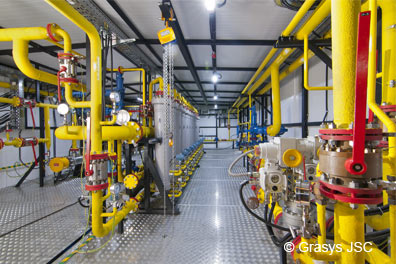
A hydrocarbon plant for the treatment of natural and associated gas and gas utilisation at oil and gas production facilities is the optimum solution to a number of pressing issues in the oil and gas industry.
Based on its own innovative technologies, Grasys' equipment is efficiently adapted to a wide range of applications, such as associated petroleum gas treatment, regulation of the composition of gases containing hydrocarbons, carbon dioxide, hydrogen sulphide, nitrogen, helium and other components, as well as associated petroleum gas processing and utilisation.
Product Design Options
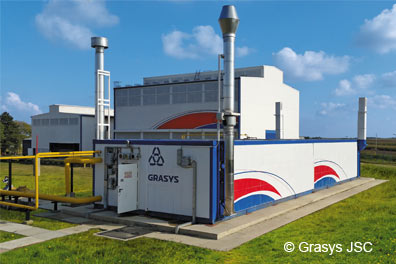
Fixed Design
Packaged Modular (Transportable)
Prefabricated Building
Grasys is one of the leading manufacturers of hydrocarbon gas treatment units. Our extensive supply experience, in-house high-tech facilities, training and after-sales services enable us to provide the best solutions for our customers.
We offer favourable conditions of cooperation and a tailor-made approach to project implementation. A technical support hotline is available at all times for a variety of issues.
Project References

Operating Procedure When Dealing With R&P Co. Grasys
Submit a request on the site or reach our specialist by phone
Grasys expert speaks to you and finds out your needs
You fill out a questionnaire with the desired equipment parameters
Our expert prepares a quotation with the most efficient solutions to your application. Contract to be concluded
We perform engineering, designing, manufacture equipment with its further testing and placing into service, etc
We ship equipment to the operational location and provide a package of documents
We are engaged in start-up operations and equipment commissioning
We provide aftersales service to ensure equipment efficient performance and reliability excellence (optional)
Advantages of Cooperating with R&P Co. Grasys

High-tech Russian manufacture

Implementation of import substitution programs

Hands-on experience in implementing over 1500 projects within 20 years

Manufacturing equipment of any size and level of sophistication

Turnkey projects (EPC-contracts)

Prompt technical support


 Telegram-bot